
Building a Precision Irrigation Platform Growers Trust
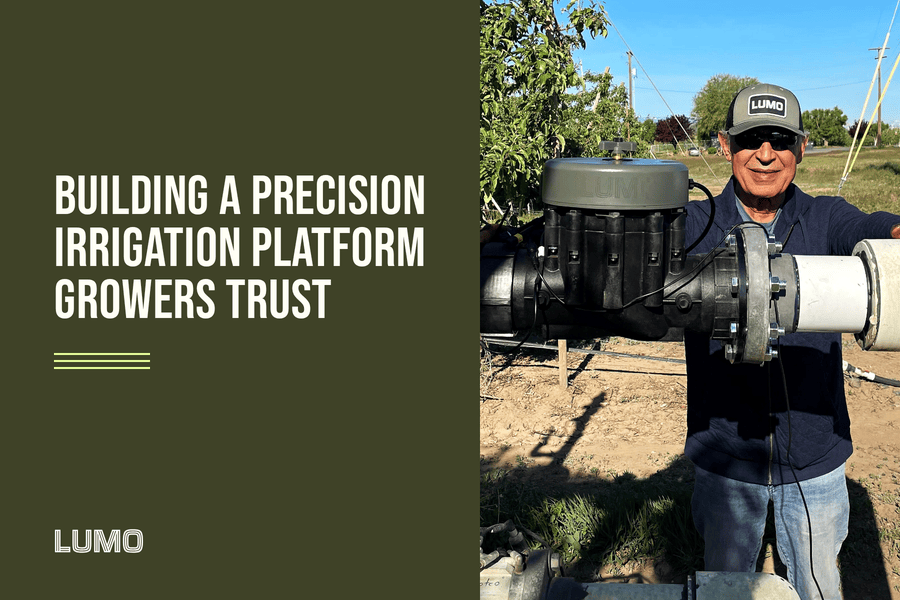
When Devon, Lumo’s CEO, broke a line and flooded his orchard, he searched everywhere for a solution. Went to stores. Asked neighbors. He even worked as an irrigator for a few weeks.
Surely, he thought, someone must have already solved this.
But instead he found unplugged controllers gathering dust. Systems that looked like they were from the 90s. Complaints about a lack of accountability. Bigger, more expensive versions of the exact same problems he had on his own farm.
When Devon first approached Henry about his idea for Lumo, Henry, our Chief Inventor, was appalled by what he saw - an industry, a process, a system that seemed untouched by modern technology.
No data. No visibility. No insight.
He had spent decades engineering water solutions in other industries and couldn’t believe how little of that technology had crossed over into agriculture.
Farmers were not being armed with the right data to dial in their precision and run their system with optimal performance. The best technologies available had simply not been brought to bear.
Yet!
This is what sent Devon and Henry down the path of building Lumo together. A shared dissatisfaction with the status quo and a shared belief that it was possible to build something better.
A broken system
Growers know irrigation is one of the most powerful agronomic levers they have to pull. Precise water application plays a critical role in determining crop quality and yield.
And yet, traditionally most growers have been forced to settle for operating without clear visibility into how much water they’re delivering to each block. They’ve had no data-driven way to know whether their irrigation plan is being executed as intended. Their system has been a black box, run on best guesses, dated assumptions and blind hope.
Running your irrigation system manually, without operational data, leads to problems that are familiar to every farm manager:
- Leaks that aren’t caught until the field is flooded
- Clogged filters that are caught by unintended plant stress
- Infrastructure issues with pressure or pump performance or old emitters that go undiagnosed for years
- No ability to determine the right number of blocks or acres to open at once
- Blind hope that each block is receiving the prescribed amount of water
- No historical record of water usage for complying with regulation or learning from season to season
- Inflated pumping costs
- Irrigating based on labor availability, rather than agronomic need
- Not being able to irrigate overnight or on weekends or holidays without relying on expensive overtime labor
- Manual errors - a missed block, a valve left closed, water left running too long
- The headache of coordinating trucks and irrigators and following up to check if everything actually ran
- No ability to fine-tune performance or dial in precision over time
- No ability to prioritize maintenance based on observed declines in system performance
These problems create what we have come to call the Irrigation Execution Gap—the difference between what growers plan to apply and what actually gets delivered in the field.
Deep down, every grower knows this gap exists. They’ve seen the issues too many times before.
But because it’s gone unmeasured, it’s gone unmanaged.
The gap has been overlooked and underestimated. And as a result, growers haven’t been able to take full advantage of their most important tool.
Without data, without great technology, irrigation hasn’t become more precise or more efficient over time. Instead it’s gotten more expensive, while failing to deliver better outcomes.
The Platform Growers Need
According to the 2022 Ag Census, only 17% of U.S. cropland is irrigated.
But that irrigated land produces over 50% of the total crop value.
Irrigation is too important to not be optimized.
What Devon and Henry both saw years ago was an industry where technology had failed to deliver the transformation that had been promised.
It wasn’t data driven. There was no visibility or accountability. No seamless automation. The tools were old and outdated, ineffective and under-utilized.
At Lumo, the vision was never to simply build smarter valves. Being able to monitor and control water volumes at a block level is a massive leap forward. But it’s also just the beginning.
We’ve always known the job to be done was more than opening and closing the system.
The vision is to build a precision irrigation platform that delivers exactly the right amount of water to the crop. Every block. Every time.
The job is to make irrigation precise, efficient, and truly data-driven. To make execution fast and seamless. To drive down the cost and ratchet up the impact.
That’s why we’re automating electric and non-electric pumps, with VFDs and without. That’s why soil moisture, weather, ET and plant-based measures are all being integrated into the platform. That’s why we’re using AI to make scheduling irrigations as easy as sending a text message.
The smart valve is the beginning of a revolution. A device that brings together the best available technologies and lays the data foundation to build even bigger and better things—pump automation that’s safe and efficient, an AI assistant that can optimize schedules and automatically flag issues that require attention, a full digital twin of the underlying irrigation system that can be used for testing and preventative maintenance.
We’re building a single, integrated platform for end-to-end irrigation management, driving operational efficiency and optimal crop outcomes for the growers we serve.
Saving them time and money. Reducing the risk to their crop and critical infrastructure. And closing the gap between what they intend to apply and what actually gets delivered in the field.
Because the best growers in the world don’t miss.